
- Home
- Tanzania Travel guide For Indian Travelers
- When Is the Best Time to See the Great Migration in Tanzania?
When Is the Best Time to See the Great Migration in Tanzania?
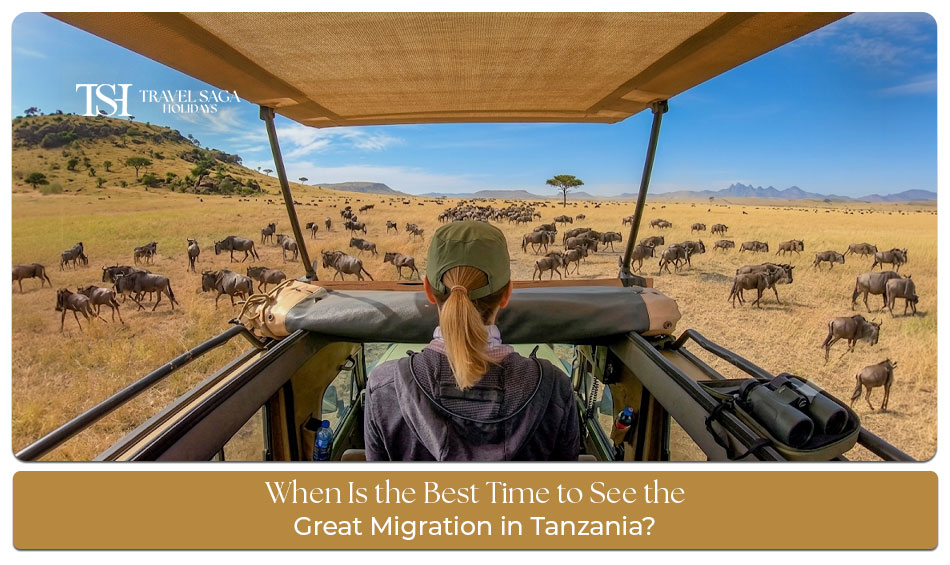
The Great Migration is one of the most talked-about wildlife events in the world. Around 1.5 million wildebeest, along with hundreds of thousands of zebras and gazelles, move in a continuous loop across the Serengeti ecosystem in Tanzania and into Kenya’s Masai Mara. The circuit runs all year, but the experience changes dramatically depending on which month you visit.
If you are planning a Tanzania safari with Travel Saga Holidays, this guide gives you a practical breakdown of the best time to book, what you will actually see at each stage, and which months offer the best return on your investment.
How the Migration Works
The migration is not a single event. It is a year-round movement driven by rainfall and grass availability. The wildebeest follow a roughly clockwise route through the Serengeti, from the southern plains in the calving season, northward through the central and western corridors, and eventually into the Masai Mara in Kenya during the famous river crossings.
Each phase of the migration offers a different kind of safari experience. There is no bad time to visit, but there is a right time based on what you want to see. Moreover, book your Tanzania tour packages in advance to avoid peak time prices.
Month-by-Month Breakdown
Here is a month by month breakdown of the great migration of Tanzania.
January – March: Calving Season in the Southern Serengeti
The short rains end around December, and by January the wildebeest are concentrated on the short grass plains of the southern Serengeti, particularly around Ndutu and the Ngorongoro Conservation Area border. This is calving season. Around 8,000 wildebeest calves are born every day during February and March.
This period is excellent for:
- Witnessing mass births on open plains
- High predator activity — lions, cheetahs, and hyenas are very active
- Photography on flat, open terrain with good visibility
The weather is generally dry and warm. This is a strong season for families and first-time safari travelers. Travel Saga Holidays recommends combining this with a Ngorongoro Crater visit. This is indeed one of the best and underrated holiday packages from India.
April – May: The Long Rains and the Move North
April and May are the long rainy season in Tanzania. The herds begin moving northwest toward the Western Corridor of the Serengeti. Safari activity is lower during this period, camps are quieter, and rates are typically more affordable.
This period works for:
- Budget-conscious travelers who are flexible
- Photographers who want green landscapes and fewer tourists
- Travelers combining Tanzania with other East African destinations
Road conditions can be challenging in some areas, and some camps in remote zones may close. Speak to the Travel Saga Holidays team before booking April–May travel to check camp availability.
June – July: The Western Corridor and Grumeti River Crossings
By June, the herds have reached the Western Corridor of the Serengeti. This is when they attempt to cross the Grumeti River, which is known for its population of large Nile crocodiles. The crossings here are generally smaller than the Mara crossings but still impressive.
The dry season begins in June. Vegetation thins out, making wildlife easier to spot. This is one of the best months to be in the Serengeti overall. Remember this if you like to opt for the Tanzania 5 Days Tour Package.
This period is ideal for:
- Travelers who want river crossings without the peak-season crowds of July–October
- Those on a Serengeti-focused itinerary
- Combining with a Zanzibar beach extension
July – October: The Northern Serengeti and Mara River Crossings
This is the peak season for the Great Migration. The herds move into the Northern Serengeti, close to the Kenyan border, and attempt to cross the Mara River. These crossings are the most dramatic part of the entire event. Thousands of wildebeest mass on the riverbanks before plunging across while crocodiles wait in the water.
The crossings are unpredictable — they can happen multiple times in a day or not at all for several days. You need time on the ground to increase your chances. Travel Saga Holidays recommends a minimum of three nights in the Northern Serengeti or the Kogatende area during this period.
Peak months (August and September) are the most expensive time to visit. Camps book out early. If you want to travel during this window, plan and book at least six months in advance.
This period is best for:
- Travelers specifically targeting the Mara River crossings
- Those who want the full high-season safari experience
- Honeymooners and anniversary travelers who are comfortable with premium pricing. Opt for the Tanzania 7 Days Tour Package and have the best time of your lives.
November – December: The Short Rains and the Return South
By November, the herds begin moving south again as the short rains arrive. The Serengeti receives light rainfall, the plains green up, and the wildebeest return toward the southern Serengeti and Ndutu. Crowds thin out compared to the peak months, and rates come down.
This period works well for:
- Travellers who want good wildlife without the July–October crowds
- Those combining Tanzania with a Zanzibar holiday
- Last-minute planners looking for better availability
Which Month Is Actually the Best?
There is no single answer. The right time depends on your priority:
| What You Want to See | Best Months |
| Calving and predator action | January – March |
| Green landscapes, fewer tourists | April – May |
| Grumeti crossings, dry season wildlife | June – July |
| Mara River crossings | July – October |
| Good wildlife, lower rates | November – December |
For most Indian travellers visiting Tanzania for the first time, Travel Saga Holidays recommends either the calving season (January–March) or the Northern Serengeti crossings (August–September). Both offer strong wildlife density and memorable safari experiences.
Practical Information for Indian Travellers Visiting Tanzania
Flights: Direct or one-stop connections from Mumbai, Delhi, and Bangalore are available to Kilimanjaro International Airport (JRO) or Julius Nyerere International Airport (DAR) in Dar es Salaam. Common layovers are in Nairobi, Doha, Dubai, or Addis Ababa. Travel Saga Holidays can assist with flight coordination as part of your Tanzania package.
Visa: Indian passport holders require a visa to enter Tanzania. A single-entry tourist visa can be applied for online through the Tanzania Immigration portal (eservices.immigration.go.tz) or on arrival. The current fee is USD 50. A East Africa Tourist Visa (USD 100) covering Tanzania, Kenya, and Uganda is available if you plan to cross into Kenya during the Mara River crossing season. Apply for your Tanzania tourist visa for Indians with us.
INR Pricing: Travel Saga Holidays quotes all Tanzania safari packages in Indian Rupees with no hidden foreign exchange charges. Package pricing includes accommodation, game drives, park fees, and domestic transfers as specified.
Best Bases: Depending on the season, key base areas include Ndutu Lodge area (calving season), Western Corridor camps (June–July), and Kogatende/Lamai (August–October). Travel Saga Holidays selects accommodation based on migration position at the time of travel.
Takeaways
This blog covers all the months and their detailed explanations on The Great Migration that happens in Tanzania. If you have any further queries or doubts, feel free to reach out to our dedicated team of experts who can assist you in all matters related to Tanzania. Contact us and know more about how you can plan your trip during the Great Migration and witness a stunning phenomenon with your own eyes. There are a lot of things that one needs to plan out before going on a trip, so why wait? Start planning your Tanzania trip from India today!
FAQs – When Is the Best Time to See the Great Migration in Tanzania?
The best time is June to October for wildlife viewing, while July to September is ideal for the famous Mara River crossings.
The Serengeti National Park is the best place to witness the Great Migration throughout the year.
A 5 to 7-day safari is ideal for experiencing the migration and exploring Tanzania’s top wildlife parks.
The dramatic Mara River crossings usually take place between July and September, depending on rainfall.
Yes. It is one of the world’s greatest wildlife spectacles, featuring millions of wildebeest, zebras, and predators in their natural habitat.
Yes. Many travellers combine a Serengeti safari with a relaxing beach holiday in Zanzibar for a complete Tanzania experience.
FAQs – When Is the Best Time to See the Great Migration in Tanzania?
The best time is June to October for wildlife viewing, while July to September is ideal for the famous Mara River crossings.
The Serengeti National Park is the best place to witness the Great Migration throughout the year.
A 5 to 7-day safari is ideal for experiencing the migration and exploring Tanzania’s top wildlife parks.
The dramatic Mara River crossings usually take place between July and September, depending on rainfall.
Yes. It is one of the world’s greatest wildlife spectacles, featuring millions of wildebeest, zebras, and predators in their natural habitat.
Yes. Many travellers combine a Serengeti safari with a relaxing beach holiday in Zanzibar for a complete Tanzania experience.