
- Home
- Schengen visa for Indians
- Schengen Visa for Self-Employed Indians: Documents, ITR and Financial Proof
- Schengen visa for Indians
- On 08.11.2026
- Nishtha Dubey
- Tags International Travel from India
Schengen Visa for Self-Employed Indians: Documents, ITR and Financial Proof
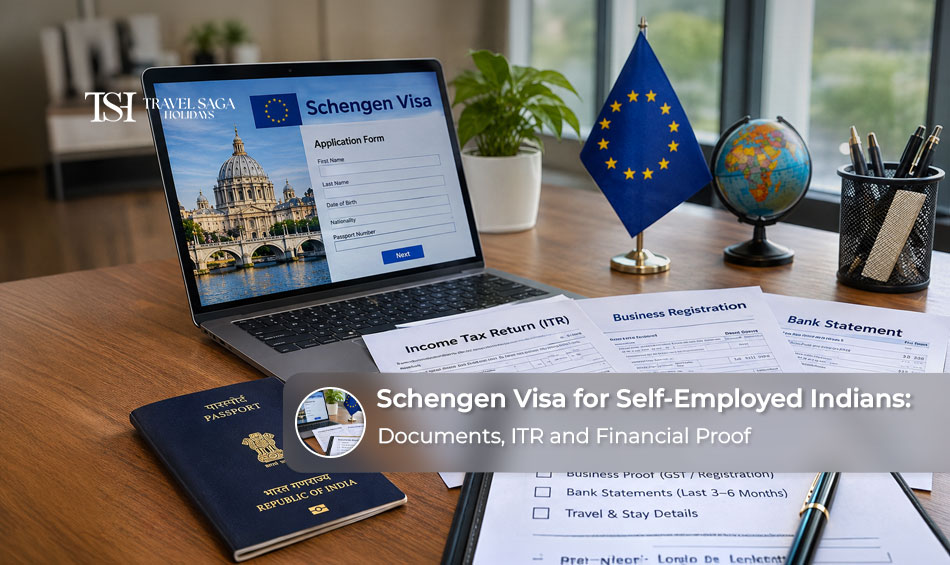
It is hard to get a Schengen Visa, and it becomes harder if you are applying for a Schengen Visa for self-employed Indians. Many Independent professionals and business owners in India believe this, which stops them from applying altogether due to the fear of Visa Rejection. The European immigration department does not exactly discriminate against entrepreneurs; they simply evaluate them from a different point of view. Consulates need to verify business proof for a Schengen visa for Indians, active operations, and need a stable bank statement for a Schengen Visa for the self-employed for Schengen Visa for self-employed Indians. For the same, this blog is going to provide all the details about the core document checklist and financial proof for a Schengen visa for self-employed Indians.
Why Self-Employed and Business Owners Face Extra Scrutiny?
When you apply for a Schengen Visa as a salaried employee, you enjoy a straightforward verification process with a formal No Objection Certificate (NOC) and consistent monthly salary slips showcasing your stable financial and job situation in your home country. However, as a business owner, you lack a third-party employer to vouch for your professional status, making your documentation process more complex. To overcome this, a Schengen visa for self-employed Indians must have these 3 things to legitimise the application.
- You need to provide a well-defined purpose for your Schengen region travels rather than just information about an open-ended stay.
- You should provide your Bank statement for a Schengen visa for self-employed applicants with a stable bank balance to showcase that your business is stable, with verifiable legal cash flow to fully cover all your travel expenses.
- You must have business proof for a Schengen visa for Indians to showcase strong ties to India and prove your intent to return to your home country. Moreover, family commitment creates a powerful economic tie anchor that guarantees your return.
Core Documentation Checklist for Self-Employed Indians
Here are the core documents you will need to apply for a Schengen visa as a self-employed Indian. Planning to travel further than the Schengen Region? Apply for your International Tourist Visa for Indians for more information about the visa application requirements for Indians.
Valid Indian Passport
Provide an Indian passport with a minimum of 3 months’ validity past your return date, with 2 blank pages. Moreover, make sure to provide copies of all your old passports.
Complete the Schengen Visa Application Form
Provide a complete Schengen Visa Application Form with all the details filled carefully, matching your passport details without any typos or errors.
Standard ICAO-compliant photographs
Provide a recent coloured passport-sized photograph with a white background. Make sure that you get your photograph taken against a white background and not the standard blue background used in India.
Proof of Business Ownership
To showcase your Business proof for a Schengen visa for Indians, these are the documents you need to provide. For further information, read the Complete Schengen Visa Documents Checklist for Indian Applicants blog to understand the core requirements for a Schengen visa for Indians.
Sole Proprietorships
- GST Registration Certificate with Annex A and B, if applicable to your business
- MSME/ Udyam Registration Certificate for your business
- Shop and Establishment Act License or local municipal trade license
- Proprietor PAN card and Aadhaar card.
Partnerships
- A notarised Partnership Deed
- Partnership Firm PAN Card and registration certificate.
Private Limited Companies
- Certificate of Incorporation issued by the Ministry of Corporate Affairs (MCA)
- Company PAN Card
- Memorandum of Association (MoU/ MoA) and Articles of Association (AoA)
Income Tax Returns and Tax Compliance
Once you are aware of the necessary documents to provide for your Schengen visa as self-employed Indians, you should also know why it is necessary to provide an Income Tax Return. An Income Tax Return is your main legal proof of income and financial standing in India if your total income exceeds the basic exemption limit. Visa officers do not accept casual bank deposits or self-declarations as proof of income. You need to provide verified government documentation to ensure you have the means to fund your trip. Here are the required ITR forms you need to apply for a Schengen visa as a self-employed Indian:
- ITR 3: This is required to be filled by individuals with an actual business who maintain full books of accounts and report actual profits.
- ITR 4: This is used by resident individuals, HUFs, and partnership firms opting for the Presumptive Taxation Scheme.
- Personal ITR vs. Business ITR: Individuals who have a combined personal identity and business earnings should file an integrated return instead of filing a separate corporate return.
Note: Check out the Schengen Visas official site to understand the major requirements for a Schengen Visa.
Financial Proof: Personal vs. Business Bank Statements
For Financial Proof for self-employed Indians applying for a Schengen visa, your business financial health is equally important as your personal assets. Here is how to structure your financial proof to meet strict Schengen compliance.
| Document Type | Core Requirement & Duration | Liquidity & Financial Threshold | Key Pattern & Strategic Tips |
| Personal Bank Statements | Last 3 to 6 months of statements | Steady, realistic balance covering flights, hotels, and daily allowances | Avoid sudden large deposits right before applying; show regular withdrawals for living expenses |
| Business Bank Statements | Last 3 to 6 months (stamped and signed by the bank) | Satisfy destination minimum (€45–€100/day/person); aim for 2x the threshold | Match transactions with invoices, GST returns, and ITR-V |
| Secondary Assets (FDs, Mutual Funds, Shares, PF) | Proof of assets showing ties to India (acts as secondary support only) | Does not replace active cash flow or liquid personal balances | Visa officers prioritize active liquidity over locked-up wealth |
Note: Still confused? Apply for your Schengen Visa for Indians and let us handle your Schengen Visa Application.
Enquire Now: Schengen Visa Application
Crafting the Winning Cover Letter as a Self-Employed Applicant
While you are applying for Schengen Visa for self-employed Indians, you need to provide a cover letter as a self-employed applicant. Here are some recommendations that you should follow for the same. Check out the best countries you can apply to get a visa easily; read the blog Easiest Schengen Visa Country for Indians in 2026.
- The Header: Make sure to provide the official company letterhead, current date, and the embassy/consulate address on the header.
- The Introduction and Role: Make sure to introduce yourself and your company properly and clearly. State your name, passport details, and your exact role as the owner, director, and partner in the business. Moreover, provide the registration details of the company.
- Trip Itinerary: Provide a clear and concise outline of your day-to-day travel plans, cities you will visit, and pre-booked accommodations.
- Financial Funding: Specify that you are self-funding your trip using your personal or business bank account. For tourism, it is recommended to use your personal bank account mostly.
- Assurance of Return: Provide proof of ties in India to showcase your intent of returning to India to manage your current business operations.
Common Pitfalls & How to Avoid Rejection
Once you are all aware of all the requirements for your Schengen Visa for self-employed Indians. You need to make sure you do not commit the same mistakes that most travellers make that get their Schengen Visa rejected. Read Schengen Visa Rejection Reasons and Solutions for more information about the common mistakes you must not make to get your visa approved.
Mixing Personal and Business Finances
Intermixing your business and personal expenses clumsily can create speculation about your true disposable income. Make sure to maintain separate bank accounts and present clean bank statements differentiating between your business revenue and personal cash flow.
Last-Minute Account Padding
Making sudden large cash deposits in your bank before applying can trigger an immediate red flag response from your immigration officers. If you are depositing a large cash influx, provide a valid reason for it.
Unverifiable travel arrangements
Do not submit an incomplete day-to-day travel itinerary or unconfirmed dummy flight tickets. This can hinder your application’s credibility. Make sure to provide an active and verifiable booking with logic and proper trip layout.
Note: Once you are finished with your visa application, check out the Holiday Packages from India to check out the Schengen countries you can visit on your tour.
To Conclude
Now that you have all the information about the Schengen Visa for self-employed Indians. Do not just give up because the process seems harder. Make sure that you are following all the necessary information provided to you before applying and get your visa easily. Moreover, make sure to provide a clear bank statement for a Schengen Visa for self-employed Indians, ITR, and business proof for your Schengen visa. Apply for your Schengen Visa for self-employed Indians with Travelsagaholidays.in for hassle-free visa assistance.
FAQs: Schengen Visa for Self-Employed Indians
As you do not have a third-party inclusion to justify your intent to return, you must prove that your business or freelance practice is active and legally recognized in India with business proof, business invoices, and professional credentials.
Most Schengen country immigration departments ask for personal and business Income Tax Return acknowledgements covering two assessment years, along with income computation. If you are a new business and freelancer, you need to provide bank deposits rather than submitting artificial numbers.
Applying with no ITR can be risky. However, if you are a freelancer without any formal company documents or a strong personal ITR, you can explore having an immediate family member officially sponsor your trip. They must provide strong ITRs, Form 16, and bank statements.
A cover letter is a vital document for a self-employed visa applicant as it provides the consulate with information about your self-employment, business, or freelance work; your purpose of travel with a detailed itinerary; and an explanation of how your business works.
You should provide bank statements for usually 3 to 6 months, with a minimum balance of ₹ 3 to ₹ 5 lakhs or more in your stable savings/ current accounts for a short trip. For more information, visit the frequently asked questions page.